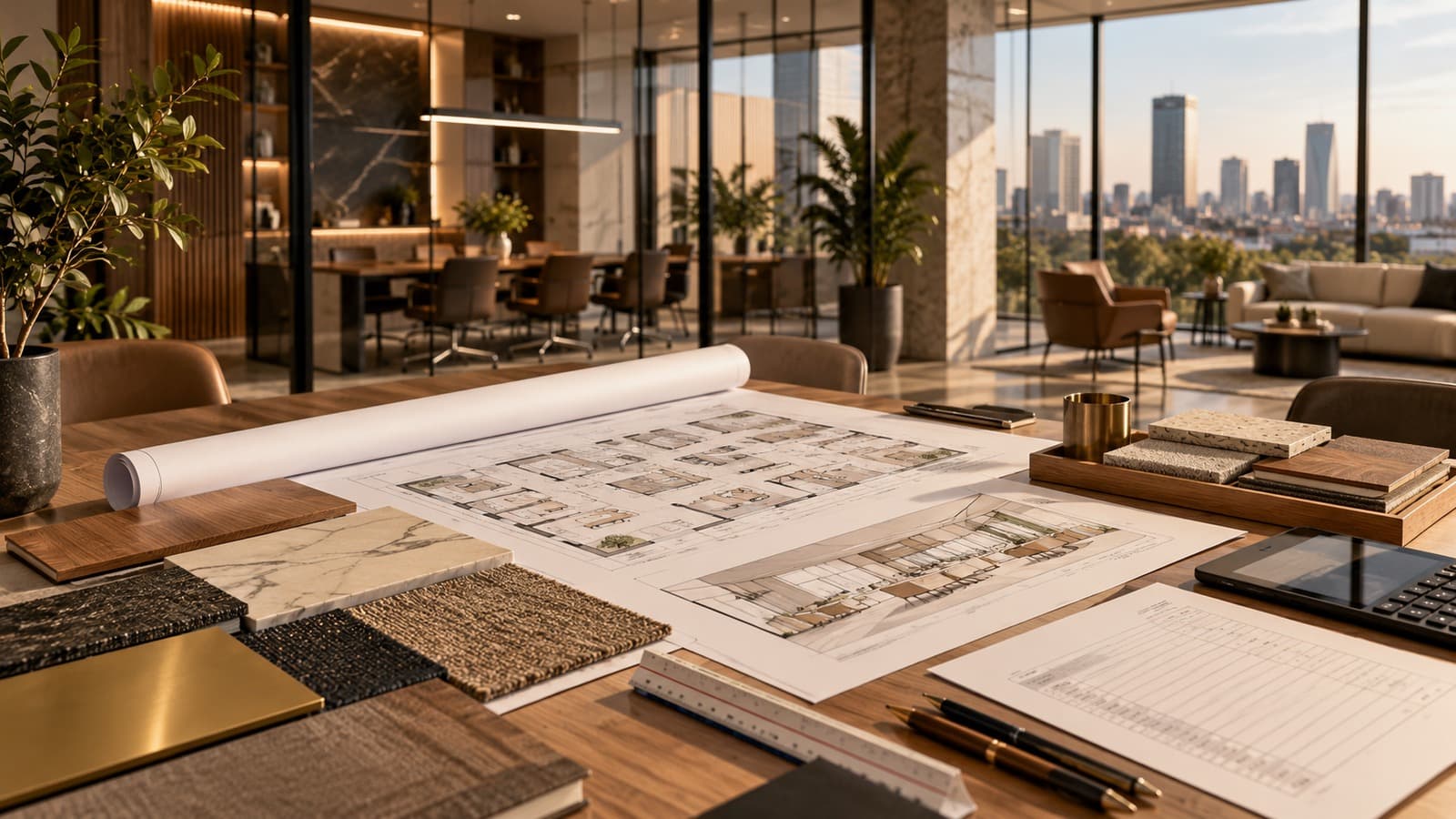
One thing I have come to appreciate more and more in this industry is that an interior designer's influence often starts much earlier than people realise.
Long before there is a tender. Long before there is a BOQ. Long before procurement begins. And sometimes, long before the client is even sure that they have a project.
A conversation may begin very simply: “We need to move offices.” “We have outgrown our current space.” “We want to refurbish this floor.” “Our workplace no longer represents who we are.” “We have taken another building. What can we do with it?”
At that point, there may be no defined scope, no construction programme, no procurement strategy and sometimes not even a clearly established budget. There is simply a business need.
And very often, one of the first people helping the client turn that need into something tangible is the designer.
Before there is a project, there is usually a problem to solve
Clients do not necessarily wake up wanting to procure partitions, ceilings, furniture, lighting, flooring or textured finishes. They are usually trying to solve something else.
Perhaps the organisation is growing. Perhaps teams are not collaborating well. Perhaps the current office feels tired. Perhaps the company is repositioning its brand. Perhaps the existing space is simply not working operationally.
The designer's job begins by understanding that problem. How many people need to work here? How are they working? What is changing within the business? What should clients experience when they enter the space? What level of investment makes sense? What needs to happen immediately, and what can be phased?
Only after those questions begin to be answered can the physical solution emerge. That is why I increasingly think of good design as part of project creation, not merely project execution.
Designers help turn ambition into scope
There is usually a significant gap between saying “we want a better office” and having a project that can actually be priced, procured and built. Someone has to help translate that ambition.
The space needs to be assessed. Requirements need to be defined. Layouts need to be tested. Priorities need to be agreed. The appropriate quality level needs to be established. Materials and systems need to be considered. Budget expectations need to meet market reality. Technical constraints need to be uncovered. Consultants and statutory requirements may need to be identified.
Eventually, all of those decisions have to come together into a coherent design and scope. By the time a contractor receives an RFQ or a supplier receives an enquiry, a surprising number of project decisions may already have been made.
“Good designers do not simply respond to the project pipeline. They help create it.”
The project pipeline begins earlier than procurement
We often think of a project pipeline as a list of tenders, enquiries or confirmed construction projects. But the real pipeline begins much earlier.
It begins when an organisation starts considering a move. When a landlord is preparing a commercial space. When a company needs to accommodate growth. When a hotel wants to reposition part of its offering. When a healthcare provider needs another facility. When a school, laboratory, retailer or corporate office begins asking whether its current environment still works.
These are not procurement events yet. They are project formation events. And designers frequently sit close to that point of formation.
That gives the profession a valuable position within the wider construction ecosystem. Not because designers control every purchasing decision — we do not — but because our work helps define the problem, the solution, the specification and ultimately the demand that moves downstream.
This matters to manufacturers, suppliers and specialist contractors too
For manufacturers, specialist finishes companies, furniture companies, lighting suppliers, flooring businesses and other organisations serving the built environment, relationships with designers are often approached primarily from a specification perspective.
The thinking is understandable: “How do we get our product onto the specification?” But I think there is a bigger opportunity.
Instead of simply asking designers to specify a product, ask: how can we help designers solve problems better?
- Bring technical knowledge, not only catalogues.
- Explain what the product can and cannot do.
- Show new applications and relevant project examples.
- Be clear about installation requirements and lead times.
- Help compare systems and performance honestly.
- Bring physical samples where materiality matters.
- Share lessons from projects where the product succeeded — and where it did not.
- Help designers understand commercial implications early enough to advise the client properly.
That kind of relationship is far more valuable than simply dropping off a brochure and waiting for a specification. Designers often encounter the requirement while the project is still taking shape, which means suppliers who engage well can gain earlier visibility into the kinds of problems clients are trying to solve.
Good design creates commercial clarity
If designers influence project formation, then our job cannot stop at producing attractive visuals. We have to understand buildability. We have to understand cost. We have to understand materials. We have to understand procurement realities.
We need to know when something looks good on paper but will create difficulty on site. We need to understand lead times, maintenance, durability and lifecycle implications. And we need enough commercial awareness to guide clients toward decisions that can actually survive the journey from concept to completion.
A beautifully designed project that cannot be procured, afforded or built is not yet a successful design. The strongest outcome is when design brings together the client's ambition, technical reality and commercial viability.
There is responsibility in being early
Being close to the formation of a project is valuable, but it also carries responsibility. Early advice can influence how a client frames the brief, what budget they expect, which materials they consider and even whether a proposed premises is appropriate.
That is why credibility matters. A designer should be able to distinguish between inspiration and specification, between an early allowance and a fixed price, and between what is visually desirable and what is commercially sensible.
The goal is not to control the entire downstream process. It is to create enough clarity that the project can move into that process with fewer assumptions, fewer avoidable surprises and a much stronger chance of successful delivery.
From “we need something” to “we have a project”
At Curzey, this is increasingly how we think about our role. Yes, we design spaces. We develop concepts. We coordinate drawings. We specify materials. We support procurement and construction.
But before all of that, there is something even more fundamental happening. We are helping clients move from “we need to do something with this space” to “we understand what we need, what it will take and how we can deliver it.”
That transition is significant. Once there is clarity around the need, scope, design, cost and delivery strategy, an idea becomes a viable project. And when that happens consistently across multiple clients and sectors, a project pipeline begins to form.
So perhaps the value of a good interior designer should not only be measured by the spaces they have completed. We should also look at the projects they helped make possible in the first place.